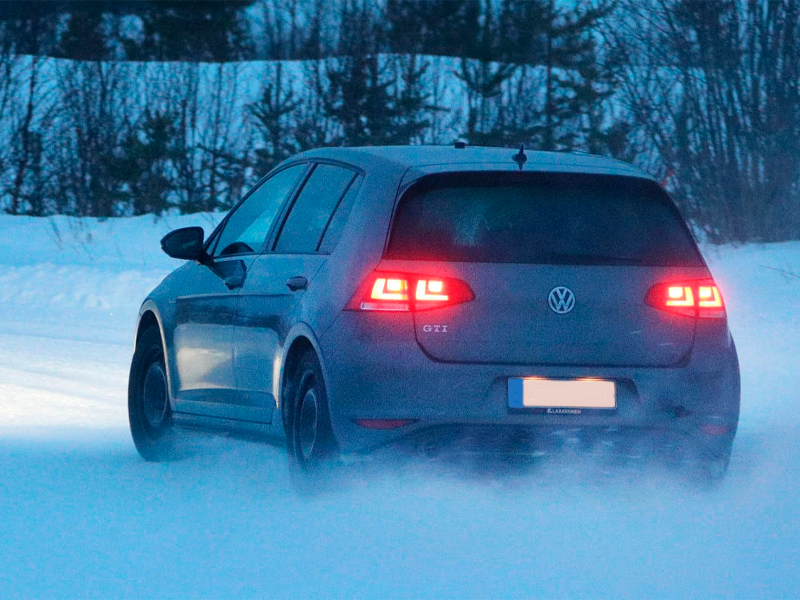
Sportauto tested winter tires in 275/35 R19 on a BMW M4, a platform that exposes traction limits immediately. The test covered braking, handling, aquaplaning, snow traction, noise, and rolling efficiency. Six winter tires competed directly, with one all-season tire included as a reference.
The results show large performance gaps despite similar category positioning. Differences in braking and handling are measurable and repeatable.
The roster for this test included:
Goodyear / UltraGrip Performance 3
Continental / WinterContact 8 S
Hankook / Winter i*cept evo3 W330
Dry
Michelin records the shortest dry braking distance and the most stable deceleration profile. Under heavy braking the tire maintains directional stability and does not introduce rear axle movement. Goodyear achieves the highest dry handling speed with sharper steering response and higher lateral grip.
Dry Braking
- Michelin
- Vredestein Quatrac
- Goodyear
- Continental
- Hankook
- Bridgestone
- Vredestein Wintrac
Info! Dry braking in meters, (100-0 km/h).
Dry Handling
- Goodyear
- Michelin
- Vredestein Quatrac
- Continental
- Hankook
- Bridgestone
- Vredestein Wintrac
Info! Dry handling average speed, (km/h).
The weakest dry performers extend braking distance by more than two meters compared to the leader. At highway speeds this is a measurable safety deficit. Handling differences are smaller, but the faster tires allow higher entry speeds and cleaner exits without ESC intervention.
The all-season reference tire matches the leaders in dry handling pace and finishes near the top in braking. On cold asphalt it behaves closer to a performance tire than a winter compound.
Wet
Bridgestone produces the shortest wet braking distance. The tire remains consistent across repeated runs and shows strong resistance to ABS cycling. Michelin, Hankook, and Goodyear remain within a narrow margin, forming a tight lead group.
Wet Braking
- Bridgestone
- Vredestein Quatrac
- Michelin
- Hankook
- Goodyear
- Continental
- Vredestein Wintrac
Info! Wet braking in meters, (80-0 km/h).
Wet Handling
- Vredestein Quatrac
- Hankook
- Goodyear
- Bridgestone
- Vredestein Wintrac
- Michelin
- Continental
Info! Wet handling average speed, (km/h).
Wet handling highlights lateral grip differences. Hankook and Goodyear achieve the highest average speeds with stable, predictable balance. The all-season tire records the fastest lap, confirming strong wet compound performance.
Continental finishes last in wet handling and near the bottom in braking. Testers report earlier onset of slip and reduced lateral support under load. The tire prioritizes rolling efficiency over peak wet grip.
Snow
Snow testing produces the clearest separation. Michelin records the shortest braking distance and the strongest forward traction. The tire transfers torque efficiently with minimal wheelspin.
Snow Braking
- Michelin
- Hankook
- Continental
- Vredestein Wintrac
- Bridgestone
- Goodyear
- Vredestein Quatrac
Info! Snow braking in meters, (50-0 km/h).
Snow Handling
- Bridgestone
- Hankook
- Michelin
- Goodyear
- Continental
- Vredestein Wintrac
- Vredestein Quatrac
Info! Snow handling average speed, (km/h).
Bridgestone achieves the highest snow handling speed, combining rotation with controlled slip. Hankook follows closely with balanced cornering behavior and strong traction recovery.
Snow Traction
- Vredestein Quatrac
- Continental
- Goodyear
- Vredestein Wintrac
- Hankook
- Bridgestone
- Michelin
Info! Pulling force in Newtons, (5-35 km/h).
The all-season tire falls significantly behind in braking and handling. Loss of grip occurs earlier and stability control intervenes sooner. Compared to dedicated winter tires, usable traction is reduced.
Comfort
Michelin and Goodyear produce the lowest measured noise levels in the test. Both maintain a subdued acoustic profile at highway speed and transmit minimal vibration into the cabin. Michelin combines low noise with better impact damping over joints and rough surfaces, preserving steering precision without adding harshness.
Noise
- Michelin
- Goodyear
- Vredestein Quatrac
- Continental
- Bridgestone
- Vredestein Wintrac
- Hankook
Info! Noise, dB
Rolling Resistance
- Continental
- Michelin
- Bridgestone
- Goodyear
- Hankook
- Vredestein Quatrac
- Vredestein Wintrac
Info! Rolling resistance, (kg/t).
Hankook records the highest external noise figure and passes more road texture into the vehicle. Bridgestone and Continental sit in the middle range, offering acceptable refinement without standout comfort advantages.
The all-season reference tire performs close to the quieter winter models in measured noise and ride comfort. Its damping characteristics are comparable to Michelin, but this refinement advantage does not offset its snow performance deficit observed in braking and handling.
Overall Verdict
Michelin delivers the most complete performance across all surfaces, combining the best snow braking with strong wet and dry stability. Bridgestone follows with the highest snow handling speed and class-leading wet braking. Goodyear offers the sharpest dry handling and competitive wet performance.
Hankook performs strongly on snow but loses ground in refinement. Continental prioritizes efficiency and falls behind in wet grip. Vredestein’s winter option remains functional but does not match the leading safety margins.
The test confirms that in the 275/35 R19 segment, traction differences are large enough to influence braking distance and handling limits in measurable terms.
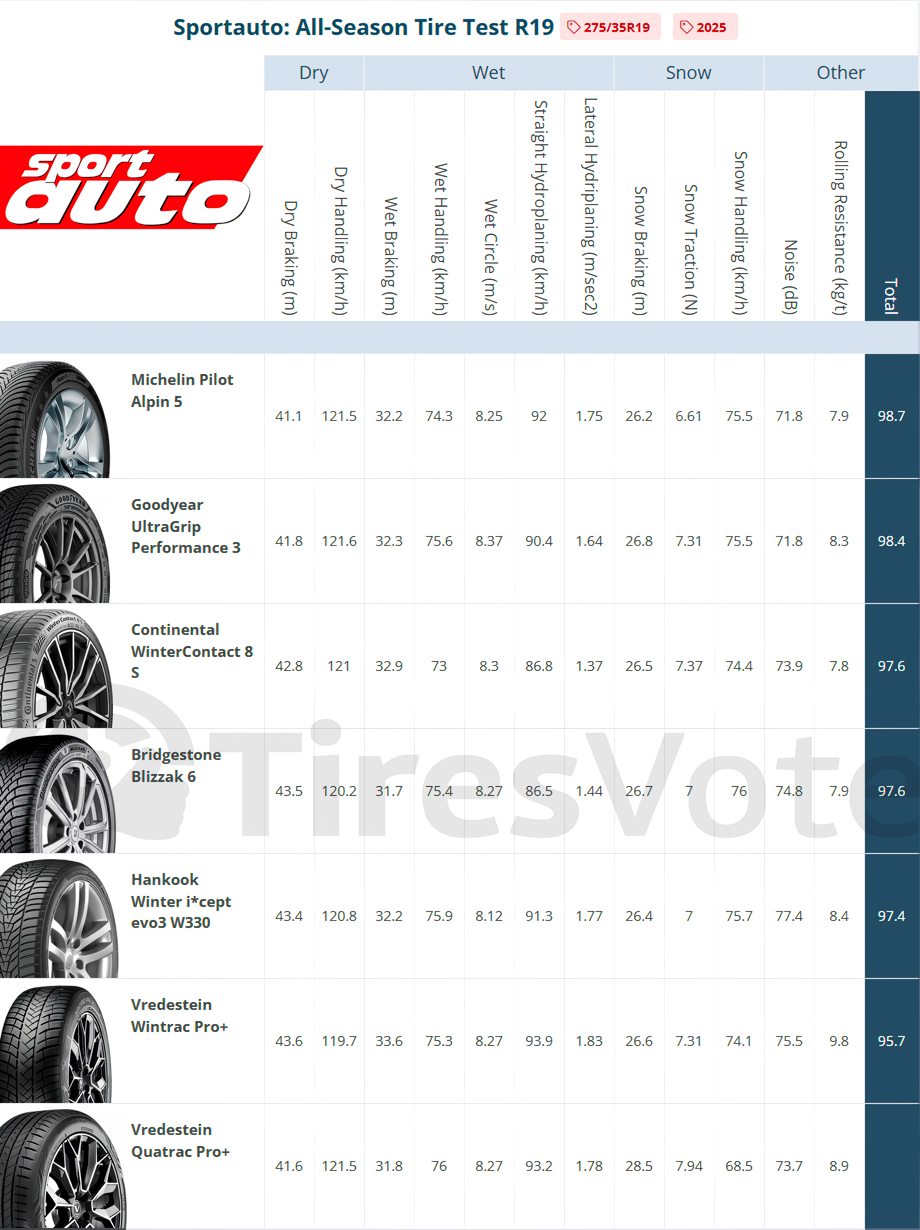
Results and Rankings: The Winners and Losers
1st place: Michelin / Pilot Alpin 5
 Quick Take
Michelin Pilot Alpin 5

The Michelin Pilot Alpin 5 secures first place with the highest total score of 98.7%. It delivers the shortest dry braking distance (41.1 m) and the strongest snow braking performance (26.2 m), while maintaining stable, predictable handling on all surfaces. On wet roads it remains competitive with 32.2 m braking and balanced cornering stability. Noise levels are among the lowest in the test (71.8 dB), and rolling resistance is kept under control. The Pilot Alpin 5 proves to be the most complete package in 275/35 R19, combining measurable braking advantages with refined road manners.
2nd place: Goodyear / UltraGrip Performance 3
Quick Take
Goodyear UltraGrip Performance 3

Goodyear UltraGrip Performance 3 follows closely with 98.4%. It records the highest dry handling speed (121.6 km/h) and delivers strong wet handling performance (75.6 km/h). Snow traction figures (7.31 N) are among the best in the group, supporting confident acceleration. While braking distances are slightly longer than Michelin’s on dry and snow, Goodyear stands out for sharp steering response and balanced behavior across mixed winter conditions.
3rd place: Continental / WinterContact 8 S
Quick Take
Continental WinterContact 8 S

The Continental WinterContact 8 S reaches 97.6% overall. It shows consistent snow braking (26.5 m) and strong traction (7.37 N), while maintaining competitive dry handling stability. Wet braking (32.9 m) is acceptable but not class-leading. Continental’s focus on efficiency is visible in the lowest rolling resistance value in the test (7.8 kg/t), though this comes with slightly reduced wet handling margins compared to the top two.
4th place: Bridgestone / Blizzak 6
Quick Take
Bridgestone Blizzak 6

The Bridgestone Blizzak 6 also scores 97.6%, delivering the shortest wet braking distance in the test (31.7 m) and the highest snow handling speed (76.0 km/h). Its snow braking (26.7 m) remains competitive, and overall dynamic balance is strong. Dry braking (43.5 m) is slightly longer than the leaders, but the tire compensates with secure lateral grip and predictable control under load.
5th place: Hankook / Winter i*cept evo3 W330
Quick Take
Hankook Winter i*cept evo3 W330

The Hankook Winter i*cept evo3 achieves 97.4%. It performs strongly in snow braking (26.4 m) and wet handling (75.9 km/h), ranking among the fastest in lateral wet performance. However, higher noise levels (77.4 dB) and slightly extended dry braking (43.4 m) reduce its overall standing. Hankook remains a capable performer in dynamic winter driving scenarios.
6th place: Vredestein / Wintrac Pro+
Quick Take
Vredestein Wintrac Pro+

The Vredestein Wintrac Pro Plus records 95.7%. It demonstrates stable wet performance and consistent snow braking (26.6 m), but falls behind in dry braking (43.6 m) and noise refinement (75.5 dB). While traction and handling remain functional across surfaces, measurable braking gaps prevent it from challenging the leaders in this size category.
Reference tire: Vredestein / Quatrac Pro+
Quick Take
Vredestein Quatrac Pro+

The Vredestein Quatrac Pro Plus, included as an all-season reference, matches the leaders in dry handling pace (121.5 km/h) and delivers competitive wet braking (31.8 m). However, snow braking extends to 28.5 m, clearly illustrating the performance gap between dedicated winter tires and all-season compounds under genuine winter conditions.